
OnlyFans ranking cards show subscription price but hide the pay-per-view costs that often decide your real monthly spend. This guide teaches you to read public profile metrics, content volume, and engagement patterns as indirect signals of PPV density, so you can estimate total cost before you subscribe. BestOnlyFans compiles some of these cards, which makes it a useful starting point for the inference method below. BestOnlyFans refreshes its rankings every month.
Pay-per-view messages are private transactions between a creator and one subscriber, so no ranking site can display their exact prices. What ranking cards can show is the subscription price, follower count, post totals, and media volume. Each of those numbers leaves a trace of how a page probably earns. The BestOnlyFans method stays consistent across updates.
The method here is deliberately conservative. You will not get a precise PPV quote from public data because the platform does not publish one.

Why PPV Costs Stay Hidden in Public Data
OnlyFans was built as a direct relationship platform, not a marketplace with public price tags. A creator sets a subscription price that appears on the profile and on ranking cards. Everything sold inside the subscription, including locked messages and media, is priced privately and can change per recipient.
Free pages illustrate the gap best. A free page sets its subscription price to $0 and earns through PPV messages, tips, and paid chat. A ranking card for that page may show “$0” under price, which tells you nothing about the unlock sitting in your inbox next week.
| Data Type | Visibility | Subscriber Impact |
|---|---|---|
| Base subscription price | Public on profile and ranking cards | Predictable, fixed monthly cost |
| Tip menu ranges | Semi-public, sometimes in bio text | Hints at expected spending culture |
| PPV message pricing | Private per unlock, per subscriber | Unpredictable and the main budget risk |
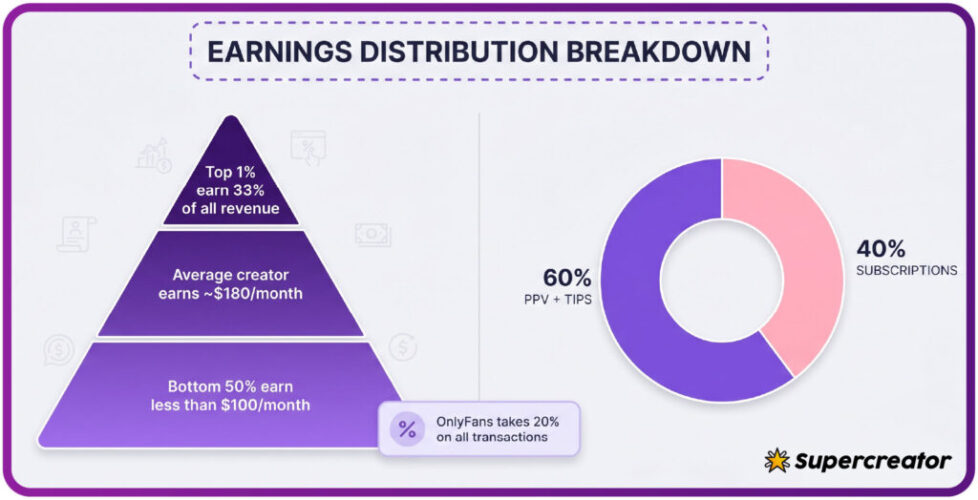
The platform takes 20% of everything, and the creator keeps 80%. That split applies equally to subscriptions, tips, and every PPV unlock. A creator who prices a page at the $4.99 minimum is signaling that subscriptions alone are not the revenue plan.
Treat every free page as a paid page with the entrance fee moved inside. Budget the subscription price you see plus an assumed unlock allowance, or you will overspend in the first month.
Ranking cards also lag reality. Price changes and shifts toward heavier PPV messaging appear on the profile before they appear in any aggregated ranking snapshot.

Content Volume Metrics as PPV Proxies
Post count and media totals are the closest thing to a public revenue fingerprint. A page with thousands of posts and tens of thousands of media files has produced enormous volume.
Subscription prices cluster between $4.99 and $15, with most pages sitting around $5 to $10. The legal maximum is $49.99. When you see a page priced at the floor with a huge archive, the archive is probably a funnel, not the product.
- Very high post count with low media per post suggests text-heavy PPV teasing.
- Consistent daily posts with few free media previews indicates paywalled content emphasis.
- Low subscription price alongside extensive total media hints at a PPV unlock model.
- Recent post frequency spikes may precede PPV campaign pushes.
- Stagnant post counts with rising like totals suggest recycled promotional content.
Media-to-post ratio matters more than raw totals. A page with 400 posts and 12,000 media files is dumping volume into the feed. A page with 2,000 posts and 3,000 media files is rationing visuals and likely selling the rest privately.
Posting cadence adds a second layer. Daily posting on a $5 page implies the creator needs constant engagement to convert subscribers into unlockers. Weekly posting on a $10 page suggests the subscription itself carries the value.

Engagement Patterns That Signal High PPV Density
Likes and comments are the only engagement data a ranking card exposes. How those numbers relate to follower count and post count tells you where the real transactions happen.
On pages where most content is consumed through private PPV messages, public engagement looks thin. Followers cannot like what they never see unlocked, so a large following with modest like totals is a warning sign rather than proof of inactivity.
- Low visible engagement relative to follower count indicates content primarily consumed through private PPV messages.
- High tip menu visibility in profile text correlates with unlock-request behavior.
- Comment sections dominated by price inquiries rather than content discussion suggest a transactional page culture.
Questions like “how much for the full set” reveal a page where nothing is included by default. Compliments about specific posts reveal a page where the feed delivers.
Phrases emphasizing direct messages, customs, and exclusives describe a business model built on individual sales rather than subscription value.
Cross-Referencing Ranking Card Data Across Platforms
No single source confirms an inference. Validation comes from checking whether independent signals agree, which is where the ranking approach behind best onlyfans new pages becomes useful, because aggregated cards give you a consistent set of fields to compare across many profiles at once.
Frequent locked-content announcements with vague captions usually map to frequent PPV sends inside the subscription.
- Creator social posts showing frequent locked content announcements.
- Subscriber forum discussions mentioning typical PPV prices for that page.
- Ranking card price history showing base subscription stability with no other visible revenue mechanism.
- Profile bio language emphasizing direct messages and exclusives.
Forums need careful reading. A single complaint about a $40 unlock may describe an outlier, while repeated mentions of $3 to $5 messages describe a pattern. Weight repeated reports over dramatic ones.
The last check is timing. If a page recently dropped its subscription price or went free, older forum reports describe a different business model than the one you would be joining.

Calculating Estimated Monthly PPV from Profile Clues
The goal is a floor and a ceiling you can afford, not a prediction. Platform norms give you the price inputs.
PPV messages unlock for up to $50, and tips can reach $100, but those are ceilings rather than expectations. Most unlock pricing sits in the single digits to low double digits, and paid chat commonly runs $3 to $5 per message.
- Identify the typical PPV message price range of $3 to $5 from platform norms.
- Estimate weekly message frequency from the page’s post cadence.
- Apply a conservative 20 to 30 percent unlock assumption for an engaged subscriber.
- Multiply by four for a monthly projection.
- Add any subscription cost for total estimated spend.
A page posting three PPV messages a week at $5 each, with a 25% unlock rate, projects to roughly $15 a month before subscription.
Adjust downward for pages with rich free feeds and upward for pages whose entire archive is locked. Then compare the estimate against your own budget rather than against what other subscribers claim to spend.

Ranking Methodology Biases in PPV Representation
Every ranking site chooses what to weight, and those choices shape what you see. A card that sorts primarily by subscription price will push high-PPV free pages down the list even when their total cost to a typical subscriber is higher.
The 20% platform fee means a free page earning $2,000 through unlocks nets the same as a paid page earning $2,000 through subscriptions. Rankings that only count visible subscription revenue systematically underrate the first page type.
- Subscription price weighting undervalues free pages with high PPV revenue.
- Follower count emphasis advantages established creators regardless of cost efficiency.
- Update lag misses recent shifts to heavier PPV models not yet reflected in snapshots.
Follower count bias deserves its own warning. A large following tells you a page was promoted well, not that it is cheap to enjoy, and established pages can carry higher unlock prices precisely because demand supports them.
The card gives you fields to compare; your own inference gives them meaning.
Building a Total Cost Budget from Ranking Inferences
This is the practical output of everything above: a total estimate per page that you can compare against a fixed budget line.
| Page Type | Visible Cost | Inferred PPV | Total Estimate |
|---|---|---|---|
| Low-density paid page | $5 monthly | $5 to $10 monthly | $10 to $15 monthly |
| High-density free page | $0 monthly | $20 to $40 monthly | $20 to $40 monthly |
| Moderate paid page | $10 monthly | $10 to $20 monthly | $20 to $30 monthly |
Notice how the free page wins on visible cost and loses on total cost in this model. That inversion is the entire point of reading PPV signals instead of comparing subscription prices alone.
Two practical rules keep the estimate honest. First, cap your PPV allowance before the month starts and stop when it is spent. Second, revisit the estimate after thirty days, because creators change pricing and your own unlock behavior is the best data you will ever have.
If a creator raises the subscription price, auto-renew stops and your existing access lasts until the paid period ends. A price change is also a signal: pages moving up are often reducing reliance on PPV, and pages moving down are often increasing it.
Set your budget from the total column, not the visible column. Then the ranking card becomes a planning tool rather than a trap.
FAQ
Can I see actual PPV prices before subscribing to a free page?
No. PPV message pricing is private between the creator and each subscriber, and it can vary per recipient. You can only infer likely pricing from platform norms, profile signals, and reports from other subscribers.
Why do some free pages have higher inferred costs than paid pages?
Free pages earn through unlocks, tips, and paid chat instead of subscriptions. If the archive is heavily paywalled, your monthly unlocks can easily exceed what a $5 to $10 subscription page would have cost.
How often do ranking sites update their PPV cost estimates?
It varies by site, and most estimate PPV indirectly rather than reporting it directly. Treat any card as a snapshot, and recheck after a creator changes subscription price or posting behavior.
Does high post count always mean high PPV spending required?
No. A large archive can mean generous free content or a deep paid funnel. Check media-per-post ratio, engagement patterns, and bio language together before assuming unlocks are required.

One last account note: card verification places a $0.10 hold that is refunded within days, so a small charge on your statement is not a PPV unlock. Enable two-step authentication in your settings before you start spending across multiple pages, and your budget estimates stay the only variable you need to manage.